Titus Andronicus
Titus Andronicus was one of William Shakespeare's first tragedies and was probably his bloodies play. It was believed to have been written between 1588 and 1593 and was supposed to be a collaboration with George Peele. It can definitely be described as a revenge play which was very popular with the audience of that time and throughout the 16th Century.
The play is set within the latter days of the Roman Empire and is also set in Rome. The play tells the story of a general named Titus Andronicus who gets wrapped up in a cycle of revenge and bloody gore with Tamora the Queen of Goths and her secret lover Aaron the Moor.

 The first showing of the play was January 24th 1594 however a more contemporary showing of the play was done in 2012 at the Globe Theatre in London and was directed by Tang Shu-wing. It was renamed Titus Andronicus 2.0. The style of the play was very minimalistic. For example, instead of Lavinia having blood gushing out from her limbs when she is amputated she wears a pair of red gloves to symbolise this happening and instead of having her tongue cut out her lipstick is smeared from her lips. The staging also was very simplistic and this was done 'to release the energies of the classical text'. All but one of the cast originated from Singapore and this was unusual to see in a London Theatre. I feel like it would have been a very smart decision to alter the original style of Titus Andronicus and make it more simplistic because it still has the same amount of emotion and it still impacts the audience in a moving way however it just gets rid of the surplus gore and violence. I feel like this way the focus is put more on the sadness of Lavinia's mutilation and the emotion of the story. I think the grey colouring of the costume is purposefully meant to suggest gloom and death and contrast against the red blood that Lavinia shed's. This obviously draws more attention to the sadness of her circumstances which I think the director was aiming for.
The play is set within the latter days of the Roman Empire and is also set in Rome. The play tells the story of a general named Titus Andronicus who gets wrapped up in a cycle of revenge and bloody gore with Tamora the Queen of Goths and her secret lover Aaron the Moor.
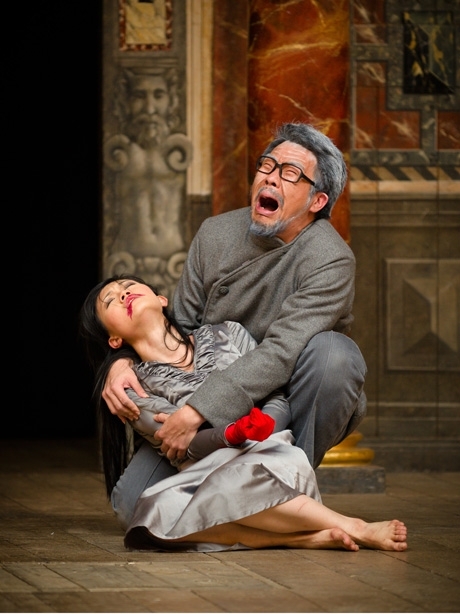 The first showing of the play was January 24th 1594 however a more contemporary showing of the play was done in 2012 at the Globe Theatre in London and was directed by Tang Shu-wing. It was renamed Titus Andronicus 2.0. The style of the play was very minimalistic. For example, instead of Lavinia having blood gushing out from her limbs when she is amputated she wears a pair of red gloves to symbolise this happening and instead of having her tongue cut out her lipstick is smeared from her lips. The staging also was very simplistic and this was done 'to release the energies of the classical text'. All but one of the cast originated from Singapore and this was unusual to see in a London Theatre. I feel like it would have been a very smart decision to alter the original style of Titus Andronicus and make it more simplistic because it still has the same amount of emotion and it still impacts the audience in a moving way however it just gets rid of the surplus gore and violence. I feel like this way the focus is put more on the sadness of Lavinia's mutilation and the emotion of the story. I think the grey colouring of the costume is purposefully meant to suggest gloom and death and contrast against the red blood that Lavinia shed's. This obviously draws more attention to the sadness of her circumstances which I think the director was aiming for.
In our
production of Titus Andronicus I played the character Aaron. At first I assumed that this would be a
different role than I had played before seeing as Aaron is the villain of the
play. I felt that I would have quite a big responsibility to maintain my
character throughout the piece and make it believable to the audience that I
could be the one that caused so much pain and chaos. I feel that at first I
definitely didn’t have the confidence to pull it off because it would be a very
masculine and masochistic role and I have no experience in playing a male role
and would have difficulties in being able to relate to someone that wished to
cause so much pain and hurt. After reading through the play I realised that I
would be able to portray my character well if I could understand my character
well. This would mean looking at my character’s given circumstances, exploring
and discovering what my character is motivated to do and why. A good way of doing
this was through asking myself Stanislavsky’s Seven Questions. This resulted in
me discovering things about my character that I had no idea would have impacted
him. These were the seven questions I had to ask myself as my character Aaron:
1. Who am I?
2. Where am I?
3. When?
4. What do I want?
5. Why do I want this?
6. How will I achieve this?
7. What must I overcome?
I first
did some research into Aaron to help me understand who he was and where he came
from. There were many websites and ways of researching this on the internet but
I also found out a lot more about Aaron by reading the play and looking at how
he responds to certain things characters say and why he might respond that way.
I feel that Aaron is the catalyst for the majority of the
wrong doings that happen in the play. He is the main cause for suffering and
revenge and the most interesting thing about him is that he is completely
unrepentable about it even when he is being told that he is to be starved to
death. There is a part of me that likes the fact that he was so defiant because
it shows how strong-minded he is despite the fact that he isn’t using this
skill for good. I would definitely describe him as being cunning and a
methodical thinker. A lot of the time he is plotting and scheming and a lot of
the time I had to play the action ‘to plot’ especially at the beginning of our
production. He is driven by revenge and also jealousy although the latter is a
theme that I think is often neglected. I feel that jealousy is a big part of
Aaron’s character. I believe that for a lot of his life he has looked at the
power and wealth that others have obtained and has wanted the same for himself.
Jealousy may have played a big part in his desire to destroy Titus because I
feel that Aaron may have thought about how Titus was partly responsible for the
death of over 20 of his sons however he is still respected and loved by the
people of Rome. It is interesting that Aaron never really admits to exactly why
he has hurt so many but does explicitly say that he takes a lot of pleasure in
it. I think it is also interesting that he is so vocal about the fact that he
has enjoyed every moment of it as he says on more than one occasion that he is
only sorry that he couldn’t do more evil things. His defiance may affect the
audience in that it might be shocking or it might be something that makes him
likeable in that he is so evil that it is almost amusing or on the other hand
people may feel sympathy for Aaron in that he is so unbelievably unwell.
I feel like a big part of Aaron's characteristics are
portrayed through his interactions with the other characters. For example, when
Aaron speaks to Nurse he is disrespectful and rude. In our production I made
the choice to emphasise my consonants when speaking to the nurse in order to
seem even more bitter and rude. Dissimilarly,
at times when Aaron speaks to Chiron and Demetrius he speaks with a much more
paternal and friendly tone in order to befriend them and manipulate them into
doing what he wants them to do.
When the play first showed in 1594 there wouldn’t have been
any black people around to perform as Aaron and so a white male would instead
paint black shoe polish or burnt cork onto his face in order to appear black. In
more recent productions Aaron has not been played as a black man. For example,
in the production performed at the Globe in 2012, Aaron was played by an Asian
actor. In other productions Aaron has been played by a black man but more focus
has been put on the racial themes of the play for example in the 70’s in a
contemporary adaptation Aaron was presented with a gorilla mask on his face.
I am happy with the way I portrayed Aaron. A difficult scene to do would have been the
scene in which Aaron is brought on stage with his child and presented to Lucius
and his army. This is because before this scene Aaron is seemingly quite proud
and arrogant however in this scene as soon as he is brought on it was important
to make it clear to the audience that Aaron was beginning to lose power. I felt
that I needed to show this through my facial expressions. I wanted to make it
seem like I was trying to keep on a brave face and maintain my defiance however
I wanted to make it clear that Aaron was threatened in this position and feels
like he is losing despite all of his efforts to be rich and almighty.
I think that I did a good job of making it evident to the
audience that Aaron is a complex and challenged character but I feel that my
end speech should have been actioned more thoroughly because looking back I feel
that Aaron may have found his sentencing to death a little bit amusing because
in his mind his death would not undo all of the bad things that he had caused
to happen and therefore he doesn’t understand why Lucius and his army cannot
see that Aaron has won. I feel that Aaron would also find this amusing. I feel
that if I had actioned it more I would have perhaps noticed Aaron’s potential amusement.


